Causal Inference Tooling
A DAG editor for a web browser, and an MCP server for AI agents, built for pharmacoepidemiology and real-world evidence.
What's Inside
A drag-and-drop editor and a Model Context Protocol server, sharing one identification engine. Each can be used on its own.
Surface 01
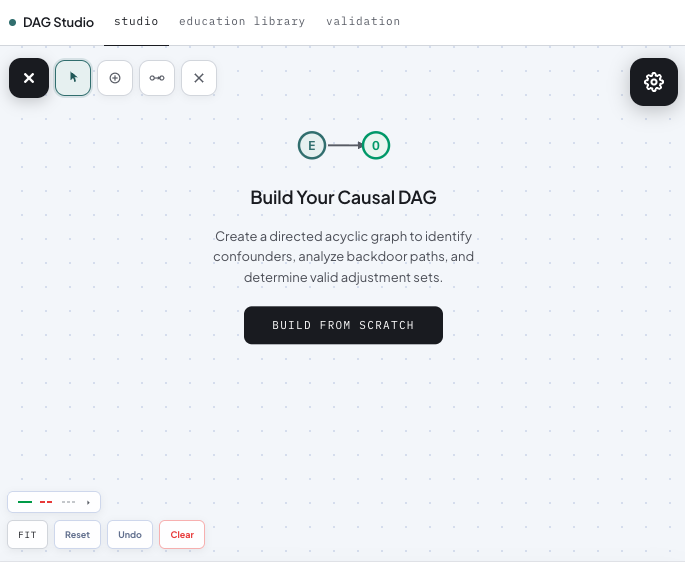
A drag-and-drop DAG editor with an in-browser causal-inference engine. Backdoor paths, adjustment sets, identifiability checks. No install required.
Surface 02
The same engine exposed as a Model Context Protocol server. AI assistants can query identifiability, suggest adjustment sets, and flag overadjustment, with citations.
The Editor
The MCP Server
Alongside the editor, DAG Studio also runs as a Model Context Protocol (MCP) server. The intent is not to have an LLM "draw a DAG for you." It is the opposite. When an analyst is reasoning about study design with an AI assistant, the AI should be able to query a real causal-inference engine to check identifiability, suggest adjustment sets, and flag overadjustment, rather than hallucinating about d-separation.
Tool surface (v1)
dag-studio-mcp/ subdirectory).One-line install will be available across Claude Desktop, Claude Code, Cursor, and Cline at npm release. Notify me →
Validation & Scope
DAG Studio's identification engine is gated against two reference implementations: the canonical DAGs and identifiability results in Pearl (2009), and the dagitty R package. The Validation tab in the live editor reports the current concordance: 15/15 across the canonical battery. Open the Validation tab →
Get Involved
DAG Studio is open source. Issues and pull requests are welcome on the GitHub repository. Inspectable tooling is the right shape for software that may inform regulatory submissions, and community review makes the engine better.
If your team is considering integrating DAG Studio into protocol development workflows, a small pilot program is open. Pilot scope: two protocols, four weeks, written feedback in exchange for early access and direct engine support. Pharmacoepidemiology and real-world evidence teams are the primary audience.