LLM agent
Answers questions, cites text
Reads the paper, answers the signalling questions the algorithm actually reaches, and supplies the evidence for each one.
MCP
ROBINS-I MCP server · 9 tools
Deterministic. Holds the seven domain algorithms as explicit edge graphs and walks them.
01
Ingest the paper and its supplement
via MCP
parse_document builds a source-tagged map and returns a survey of fifteen evidence cues: where each domain’s evidence tends to live, and which absences already look real. The supplement matters: the target-trial specification often lives only there.
02
Two gates, before anything is scored
via MCP
set_prespecified_confounders supplies the review’s list of important confounders. Domain 1 asks whether all of them were controlled, and “important” is the reviewer’s judgement, not the paper’s covariate table. So the server refuses to score domain 1 without it rather than silently substituting one for the other. Then specify_result settles C4, which selects which of domain 1’s two question sets even exists.
03
Answer one domain at a time
agent
assess_result returns a scaffold per domain, never one flat rubric; most of the forty signalling questions are unreachable on any given path. On the reference assessment, twenty-four were never reached, and the algorithm’s branching decided that, not the assessor.
04
Evidence is enforced, not requested
server-side
Every quote is resolved to a character offset in the ingested text; an unfound quote is rejected, with the nearest actual text returned so it can be corrected. A claim that the paper is silent must name a search cue, and the server runs the search: prose asserting that you looked is refused, because it cannot be audited.
05
The algorithm decides
deterministic
No tool accepts a domain judgement as an input. The six domain algorithms and the overall algorithm are explicit edge graphs, traced arrow by arrow from the published flowcharts, and the verdict is the traversal. A reviewer may override it, with a recorded justification and both values shown.
06
A stamped assessment, and a ratification queue
artifact of record
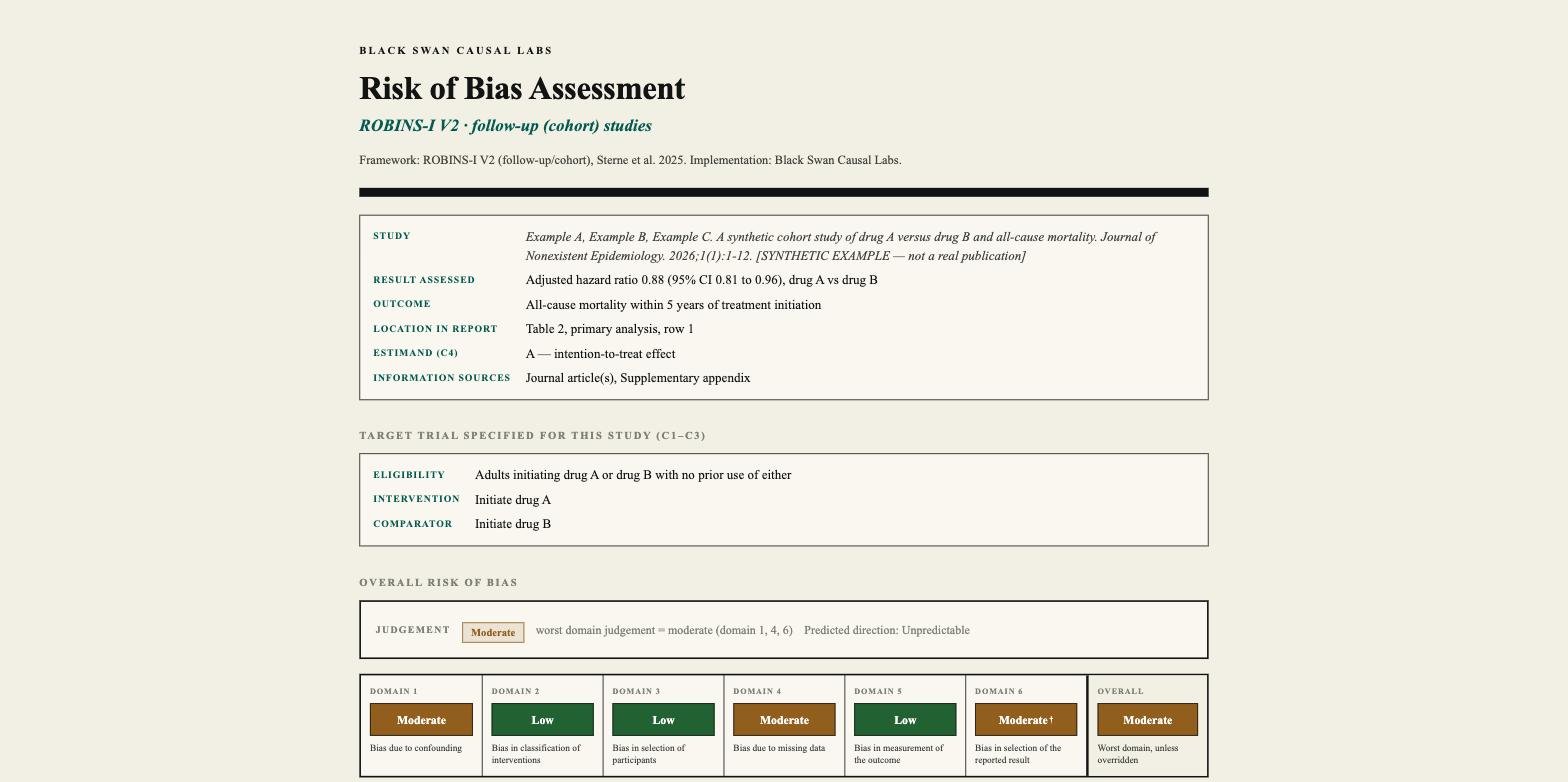
The report carries a provenance stamp bound to the ingested text and to a fingerprint of the traced algorithms, so a later correction is detectable in work produced under the earlier version. Anything resting on reviewer judgement rather than the paper stays in a ratification queue: the assessment is explicitly not final until a human signs it off.
 Illustrative example · synthetic data, not a real publication